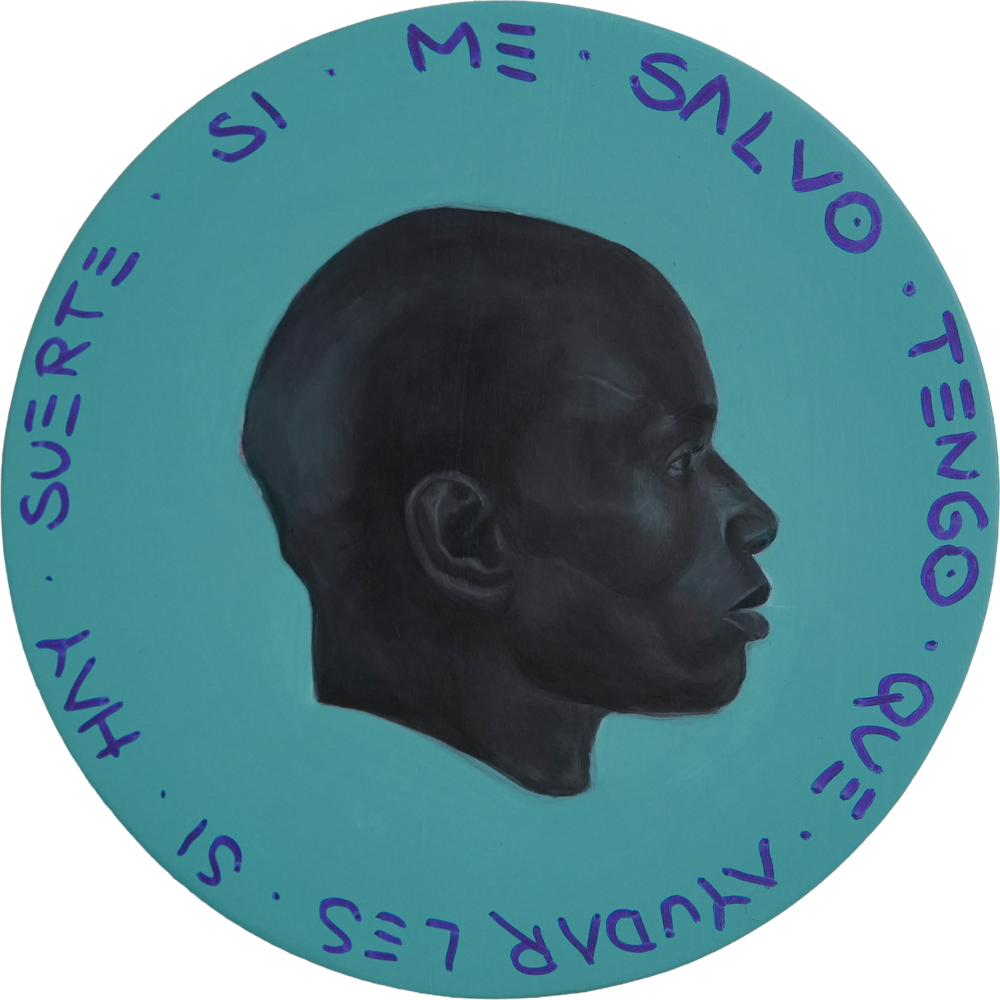
The story of Papa Yata «Paquito» Story · installations and exhibitions: LSYTSDA Sala Alterarte
Position · 0:00 / 14:38 SubtitlesOff ES EN GL Transcript 0:00 My name is Papa Yata Boye, also known 0:05 as Paquito. I came to Spain in 2006. 0:10 I made the journey in a cayuco boat. 0:16 In 2006. I 0:20 went through Gran 0:25 Canaria, then Tenerife, and 0:30 finally A Coruña. 0:37 A friend took me in, a fellow countryman who lived 0:42 in Coruña. He is no longer there; he is in Ourense. 0:48 He took me in and gave me a place to 0:53 stay after I went through Tenerife on my way to Coruña. 0:58 Then I went back to live in Coruña, 1:03 and eventually I came to Fisterra in 2015. 1:08 Well, we went through a difficult 1:12 time in Senegal. I had a profession 1:17 there, because I am a fisherman. 1:22 I live by the sea, you 1:26 see? My home village is 1:31 called Fass Boye, like my surname. 1:36 My grandfather founded it in 1:41 1929. We fished there, 1:45 but we had problems with 1:51 foreign boats, because 1:55 our country's government 1:58 sold to foreigners, 2:02 to the foreign boats that come 2:06 to fish in the inshore waters. 2:11 In the end it hurt us badly, and the 2:15 sea was almost empty. There were not many fish, 2:20 and we had problems. We 2:23 also have land to farm, 2:26 but you know a fisherman cannot 2:32 farm, because what he knows best is 2:37 going out to sea to fish. If there are no 2:40 fish in the sea, you can go onto the 2:44 land to farm, but not for 2:48 very long, because you cannot leave your 2:52 profession. We were born by the 2:55 sea, and born to fish too. What 2:58 we know is fishing. Everyone has their 3:01 own profession. There are many professions in 3:04 Senegal, but my profession is fishing. 3:10 There were no fish. I wanted to improve my 3:15 life, and I saw a way forward, I saw 3:19 a journey in the cayuco boats. I 3:23 spoke to some friends about it and 3:28 we found a solution and boarded the boat. 3:32 We were lucky: we reached the Canary Islands. 3:36 That is how it was. 3:37 It is very hard. You know that travelling by sea is very hard. 3:42 It is almost risking your life, because the 3:47 sea has no arms to hold you. 3:53 If you are out at sea and there is 3:57 an accident, it is very difficult to save yourself. 4:02 You see? It was very hard. 4:05 Sometimes you encounter strong winds at sea. 4:09 A cayuco is not like a car on 4:13 the road. With a car, you see, 4:17 if it breaks down on the road, you can 4:21 stop, get out and leave. But not at sea. 4:25 It is very hard, coming here in a cayuco. It is very hard. 4:30 But if there is no solution and we want to 4:34 survive and move forward, we have to find a solution. 4:39 I speak French, a little English. 4:42 You see? It is my language. 4:46 I did not know any Spanish. I learned it here. 4:52 When I arrived in Coruña, 4:56 I had to take 5:00 Spanish classes. I spent around 5:04 five or six years studying in Arteixo. 5:08 No, no, not fear. You see, I 5:12 will never be afraid of the sea. 5:17 I have spent fifteen days at sea fishing, 5:22 fifteen days, eight days at sea, fifteen-day trips. 5:27 But what was hard for me was, for 5:32 example, some of the people on the 5:37 boat who knew nothing about the sea. 5:40 You see? That was hard for me. 5:46 Those people knew nothing about the sea. 5:51 They got seasick and vomited, you see? 5:56 They could not eat. That really 6:01 hurts me. But in the 6:05 end we arrived safely, without problems, 6:10 because we had good 6:13 weather and arrived safely. 6:16 Arteixo, because of the time… 6:22 I spent time there, 6:23 with many people there, 6:26 and people appreciated me too. 6:30 When I arrived, I had no papers. I 6:34 could not work, but I sold things. 6:40 But people cared about me a lot. 6:43 Even now, people from Arteixo call me: 6:48 “Paquito, how are you? Where are you?” 6:50 Some people come all the way from Arteixo to visit me here. 6:57 There is also a Colombian 7:02 woman who has a 7:07 bar in Vilarrodís. Vilarrodís is 7:12 near Coruña. That Colombian woman helped me 7:16 with my papers, she and her husband. 7:21 You see? Yesterday I was talking to him, 7:26 to her. Migrant people, but very good people. 7:31 There are all kinds of people among foreigners. 7:35 But being a foreigner is also very hard, 7:39 because sometimes you see good things, and you see bad things. 7:43 You are here: some people make life hard for you, 7:47 and some people stand up for you. 7:48 That combination, 7:52 you see? 7:56 It will break your heart. 7:59 If you are a person who feels anger, 8:02 in the end that anger will go away, 8:07 because you see good 8:10 things and bad things. 8:14 Those two things come together in your life. 8:17 In the end your heart will be like 8:22 the sea: very wide. You can accept everything. 8:29 You bear what is good, 8:33 and you bear what is 8:37 bad. Because being a migrant 8:41 is like going away to study. 8:44 If you go away to study, for example, 8:47 if you leave your home to go somewhere else 8:52 to study, or to earn money, 8:55 Even if you do not earn money, you gain 8:58 an education. That is part of being a migrant. 9:02 And you will also learn things about the world. 9:07 You will learn, for example, to 9:11 forgive and to help others. 9:14 I came to Finisterre because, when 9:19 I had my papers and 9:23 was taking maritime courses, there was 9:28 a fellow countryman who is now in 9:31 Ferrol, but used to live here. 9:35 He rented a house here and was 9:39 looking for a boat. He found one, called 9:42 me and said, “Someone needs a crew member.” 9:46 You see? I spoke to that 9:50 man, we agreed, and my countryman said: 9:55 “When you come, you must stay with me at 9:58 my house so you can go out to sea.” 10:02 Working as a crew member, fishing 10:06 for octopus. I started with 10:10 octopus pots, but now I 10:14 work with gillnets and fishing gear. 10:19 Most Senegalese people are responsible. Before coming 10:24 here, I had a boat in Senegal. 10:29 Now I leave it with my brothers. You see? 10:33 But when I came here, I said: 10:37 “I want to try going to Spain to work,” 10:41 not to stroll around or to look for an easy life, 10:46 because I want to earn money, you see? 10:49 I want to come here, earn money and return to my country 10:53 to invest. That is my idea. 10:57 Yes, I want to return to my country. 11:01 If I have something to invest, I must invest it there 11:04 and employ people to work there. 11:07 A Muslim is always happy. 11:11 You may have things I do not have, but I have the 11:15 most important thing. I feel I lack nothing: I have my health. 11:21 You see? As she told you, 11:24 what my religion says is: 11:28 “You must help if you have the 11:32 means.” You see? That is our culture. 11:35 Most people here have 11:39 their own home. 11:42 I live in my house; she lives in 11:45 hers with her husband and another friend. 11:48 But every Saturday, most of us get together at her house. 11:57 She deserves it. 12:00 We met here; we are all 12:03 fellow countrymen. It is African culture. 12:07 When Senegalese people meet each other once in 12:11 the street, we get to know each other: 12:16 “What country are you from?” “I am from Senegal.” 12:19 “Me too.” They will ask for your contact details, 12:24 call you, and one day we meet up. That is how it is. 12:28 No, I did not know before. I had 12:32 not thought about leaving my country to come here. 12:35 I had not thought about it. I 12:40 always told my brothers, “We have to keep 12:45 trying and work in our own country.” 12:51 You see? That was my opinion. 12:54 But we went through a difficult time. 12:58 We are a family; we cannot all 13:01 stay there. As I am the eldest, 13:04 I told them, “I will try to make the journey. 13:09 If I am lucky, if I survive, it is as though 13:13 everyone survives.” Because I am here, 13:16 but I support my family there. 13:20 At the end of every month, or whenever there 13:23 is a problem, they call me. If they call, 13:27 if I have anything, whatever I have in 13:30 my hand, I must send it to them. 13:33 Oh, in Africa it is not like here. It is 13:36 not just a father, mother and child living together. 13:40 Look, now I have my own house, 13:44 but before, I lived with my father and my brothers. 13:50 My wife lived in my father's house. 13:54 They are family homes, with more 13:58 than twenty people. It is African culture. 14:01 I am with my wife and children. 14:07 But if someone in 14:11 my family has problems, 14:14 I must take them into my 14:17 home too, so we can live together. 14:20 Well, I thank God, 14:25 because everything is for Him.